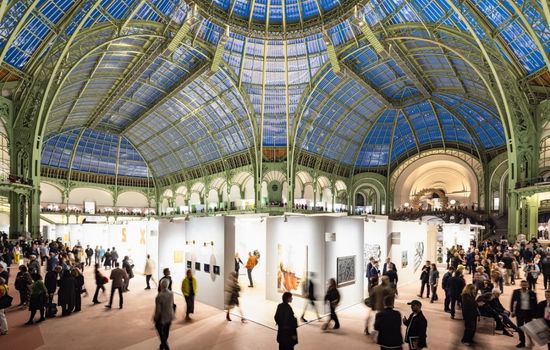
In this issue, we explore how international art fairs transformed the contemporary art market into one of its most important commercial platforms, accounting today for approximately 35% of the global market. We examine how the leading fairs emerged, what distinguishes each one, and why cities such as Basel, London, New York, Hong Kong, and Mexico City now occupy a central place within the global art circuit.
Gisela Madrigal Olivares
The Origins of Contemporary Art Fairs

The origins of today’s major international art fairs can be traced back to the world expositions held across Europe during the nineteenth century. Among the most influential was the 1900 Exposition Universelle in Paris, organized at the height of the French Belle Époque (1871–1914) in venues such as the Grand Palais and Petit Palais, both built specifically for the event.
Over several months, the exhibition brought together art, architecture, design, industry, and technological innovation from around the world. It attracted approximately 50 million visitors—a figure greater than the entire population of France at the time—and helped establish Paris as one of the leading cultural capitals of the era.
Decades later, following the Second World War, a new model emerged, focused specifically on the contemporary art market: the international gallery fair.
In 1967, Germany launched Kunstmarkt Köln ’67, now known as Art Cologne. Founded by gallerists Hein Stünke and Rudolf Zwirner in Cologne, it is widely regarded as the first international fair for modern and contemporary art in the format that continues to define the global market today.
This model transformed the dynamics of the art market. Fairs became international meeting points where galleries, collectors, curators, and institutions gather in a single city for a few days to exhibit, sell, and discover artists.
Art Basel

Founded in Basel, Switzerland, in 1970 by gallerists Ernst Beyeler, Trudl Bruckner, and Balz Hilt, Art Basel brought together international modern and contemporary art galleries under a single format and helped consolidate an increasingly global market.
Over time, Art Basel expanded to Miami Beach (December, since 2002), Hong Kong (March, since 2013), and Paris (October, since 2022), while its flagship edition continues to take place each June in Basel.
Each location serves a distinct market. Basel maintains a highly institutional and blue-chip profile, hosting many of the world’s most influential galleries. Miami Beach connects the North and Latin American markets within a week defined by art, design, fashion, and hospitality. Hong Kong strengthened the international market’s presence in Asia, while Paris reclaimed part of its historical influence within the global contemporary art circuit.
Frieze

Frieze London was launched in 2003 by the founders of Frieze magazine, Amanda Sharp and Matthew Slotover. Unlike fairs traditionally associated with established galleries and the blue-chip market, Frieze developed an identity closely linked to curatorial experimentation, emerging artists, and contemporary practices.
The main fair takes place every October in Regent’s Park alongside Frieze Masters, dedicated to historical and modern art. Over time, Frieze expanded to New York (May, since 2012), Los Angeles (February, since 2019), and Seoul (September, since 2022).
Each edition reflects the character of its city. Frieze Los Angeles maintains close ties to California’s film, entertainment, and visual culture industries, while Frieze Seoul has strengthened South Korea’s position within the international art market and helped establish Seoul as one of Asia’s leading cultural centers.
The Armory Show

Held annually in New York each September, The Armory Show takes its name from the historic 1913 Armory Show, officially titled the International Exhibition of Modern Art.
That landmark exhibition introduced European avant-garde movements to American audiences for the first time. Works by artists such as Marcel Duchamp, Henri Matisse, and Pablo Picasso transformed perceptions of modern art in the United States.
Decades later, the contemporary fair was founded in 1994 under the name Gramercy International Art Fair before adopting the title The Armory Show in recognition of that historic moment.
Today, the fair remains one of the most important platforms within the American art market, maintaining a strong presence of both North American and international galleries. Its September calendar also coincides with the beginning of New York’s autumn cultural season.
In 2023, The Armory Show and Expo Chicago were acquired by Frieze, reflecting the growing consolidation of major international fairs within global groups that now concentrate a significant share of the contemporary art market.
Zona Maco

Founded in 2002 by Zélika García, Zona Maco has become the leading contemporary art fair in Latin America. Held each February in Mexico City, it forms part of Art Week, a citywide program of exhibitions, openings, and cultural events.
During these days, galleries, collectors, artists, curators, and international art professionals converge in Mexico City, reinforcing its position within the global contemporary art circuit.
Beyond contemporary art, Zona Maco has expanded to include design, photography, and antiques, broadening its audience and collecting communities.
The fair also reflects the growth of the Mexican and Latin American art scenes over recent decades, as well as Mexico City’s role as one of the region’s principal cultural capitals.
The Impact of Art Fairs

Major international art fairs have transformed not only the art market but also the cities that host them. During fair week, hotels, restaurants, museums, luxury brands, and cultural institutions become part of a shared economic and cultural ecosystem.
The arrival of Art Basel in Miami Beach in 2002 helped position the city as one of the leading cultural destinations in the United States. In 2024, the fair generated an estimated economic impact of $547 million and attracted approximately 75,000 visitors.
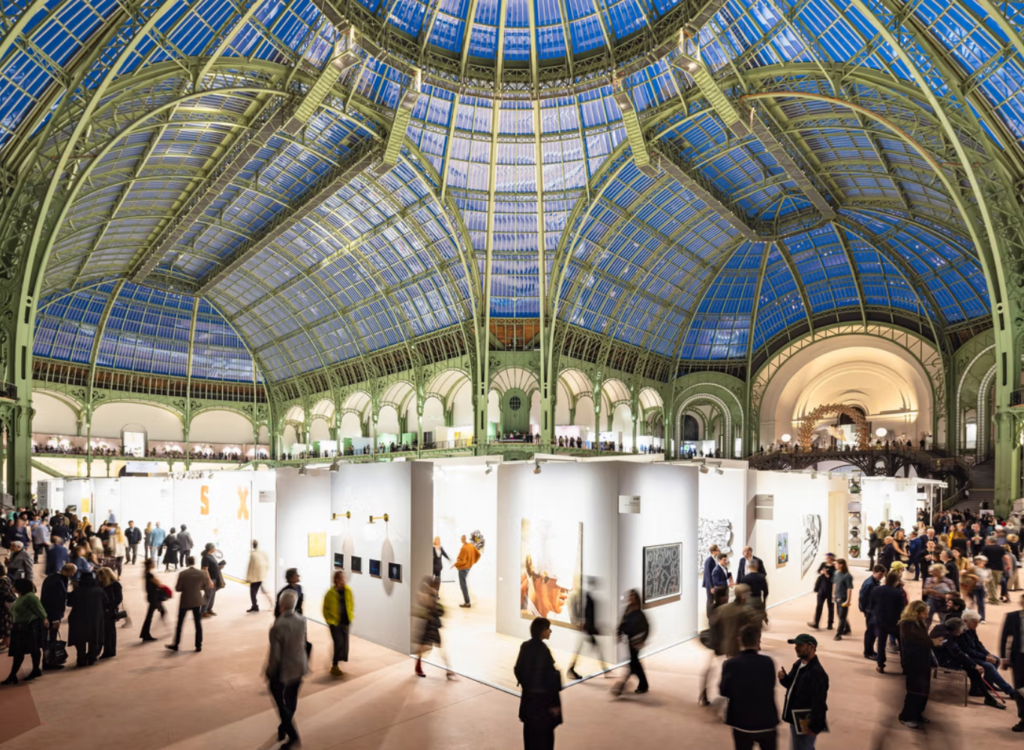
London established Frieze Week as one of the most significant moments in the European cultural calendar, while Hong Kong strengthened its role as a bridge between Asia and the West within the global art market. In Paris, the arrival of Art Basel Paris at the Grand Palais in 2022 reinforced the city’s return to the center of the international art circuit; the 2025 edition generated an estimated economic impact of €442 million.
Beyond sales and tourism, international fairs have become one of the most important platforms for visibility. In just a few days, an artwork can be seen by collectors, curators, museums, and art professionals from around the world, concentrating a significant portion of contemporary market activity within a single city.
Featured
Interview
Ingrid Buendía